
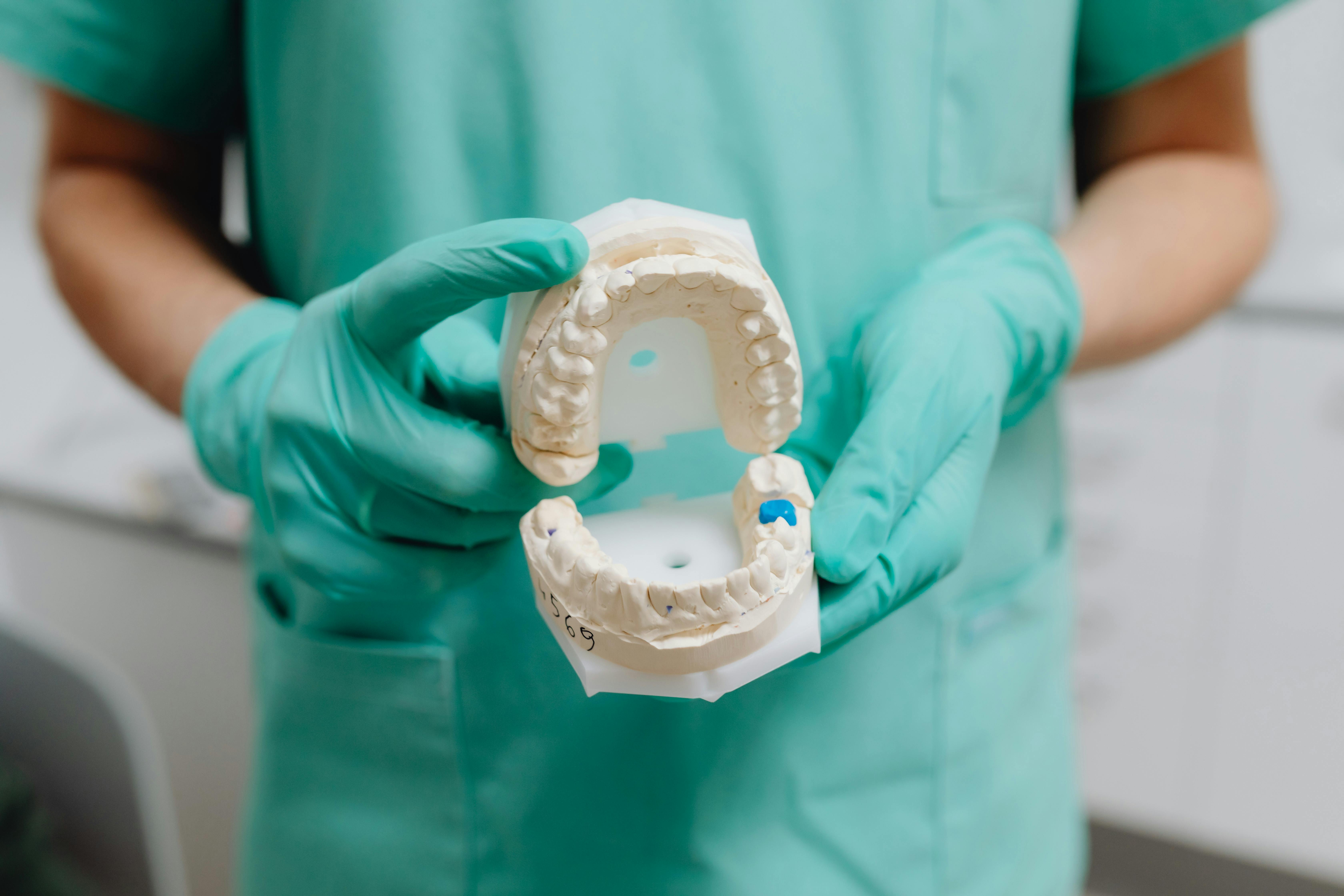
Brackets, wires and aligners work within a single dental arch. Correcting how the upper and lower teeth meet requires force running between the arches, which is the job elastics do.
Appliances within one arch have a closed force system
A wire connecting teeth in the upper arch can align, rotate and level those teeth. Every force it applies is balanced by an equal force somewhere else in the same arch.
That balance means the arch as a whole cannot be moved relative to the opposing arch. The system has nothing outside itself to push against.
Aligners have the same limitation. They reposition teeth relative to one another but cannot change where one arch sits in relation to the other.
Elastics create force between the arches
An elastic runs from an attachment on the upper teeth to one on the lower teeth. It pulls both ends toward each other, applying force across the bite rather than within an arch.
Direction is set by where the ends attach. Running an elastic from an upper front area to a lower back area produces different movement than the reverse arrangement.
Vertical and crossing configurations exist as well, used to close open bites or correct teeth that meet on the wrong side. Placement encodes the intended correction.
Why patient cooperation is structural, not incidental
Elastics are removable, which means the force exists only while the patient wears them. Unlike a wire, the appliance cannot apply force on its own schedule.
Tooth movement depends on continuous light force over time. Intermittent wear allows the tissue to reverse partway between periods of force.
This is why inconsistent elastic wear extends treatment more than most other variables. The biology restarts rather than accumulating.
Elastics move teeth, not jaws, in most patients
In a patient who has finished growing, the force is absorbed by the teeth and their supporting bone. The correction comes from moving teeth within each jaw.
In a growing patient, appliances applied across the arches can also influence how growth expresses itself. The available effect depends on the growth remaining.
Because the response differs so much by age, the same elastic setup produces different outcomes in a teenager and an adult. Timing is part of the treatment plan.
Why elastics are prescribed rather than self-selected
Elastics vary in force and diameter, and the configuration is chosen for a specific measured discrepancy. Using a different arrangement can move teeth in unintended directions.
Excessive force across the bite can tip teeth or affect their supporting tissue. Monitoring at review appointments is how those effects are caught.
Anyone in treatment should follow the configuration their orthodontist prescribed and raise problems at appointments rather than improvising a change.