
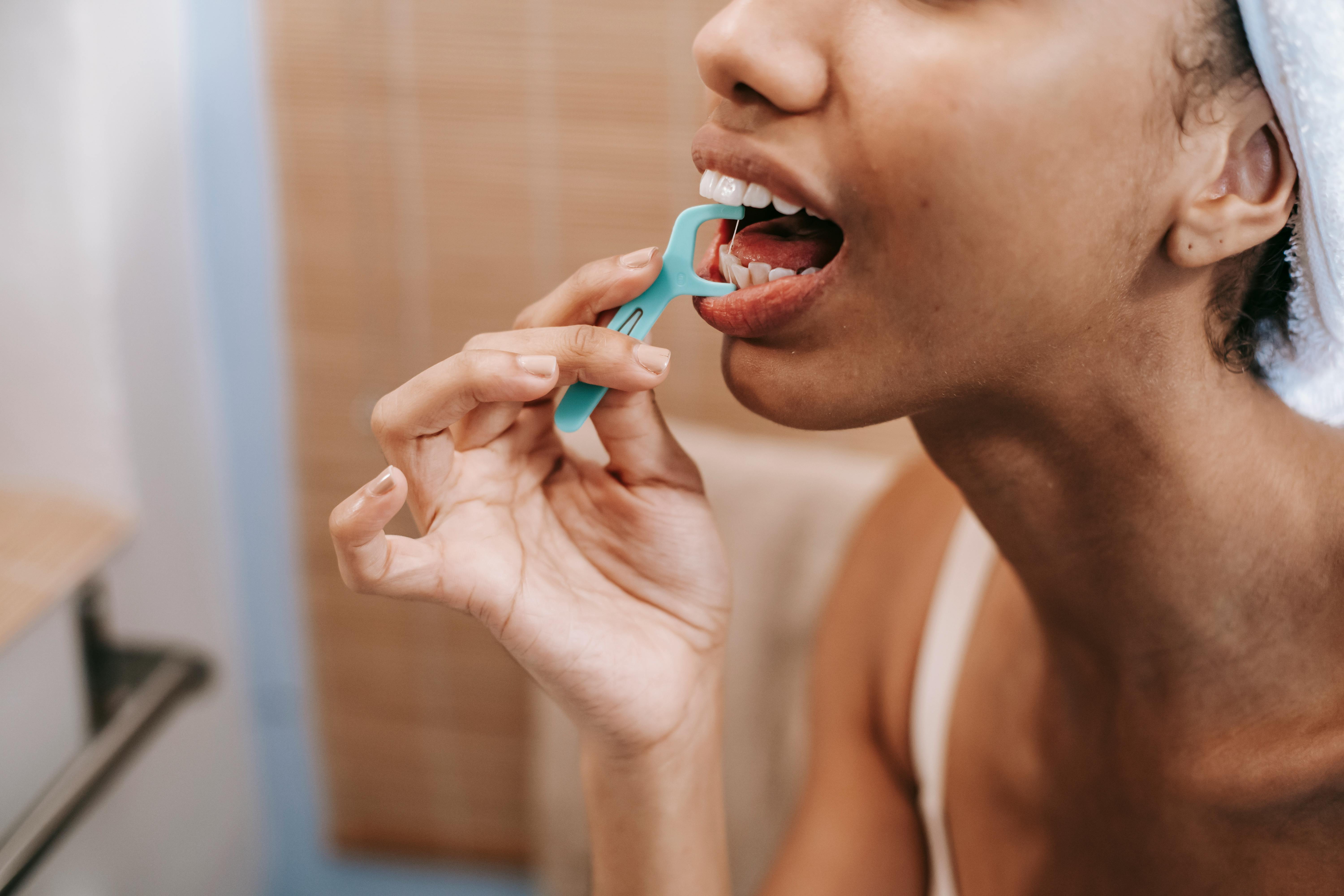
Brushing cleans the surfaces a brush can touch. Roughly two of every five tooth surfaces sit between teeth, and bristles do not reach them.
The contact point blocks the bristles
Adjacent teeth touch at a small area near their widest point, and beneath that contact the two surfaces curve away from each other into a sheltered space.
A brush filament is far too thick to pass through the contact, so it sweeps across the outside and leaves the interproximal surfaces largely untouched.
Floss is thin enough to slip past the contact and then be curved against each tooth in turn, which is the movement that actually removes the film.
Sheltered surfaces behave differently
Saliva buffers acid and delivers minerals back to enamel, but it circulates poorly in a tight space between teeth compared with an exposed outer surface.
The same shelter that keeps a brush out also keeps saliva's protective effect diminished, so the local environment stays acidic for longer after eating.
This combination is why decay between teeth is common and why it often progresses some way before becoming visible or uncomfortable.
Gums respond to what sits at the margin
Between every two teeth sits a small wedge of gum tissue, and bacterial film accumulating against it produces inflammation in that area first.
Bleeding when cleaning between teeth generally indicates inflamed tissue rather than damage caused by the floss itself.
Whether inflammation reflects ordinary gingival irritation or something requiring treatment is a clinical judgement, and persistent bleeding is a reason to be examined.
Technique matters more than the material
Floss passed straight down and pulled straight out cleans little, because it never contacts the curved surfaces it was meant to wipe.
Curving the floss around one tooth and moving it against that surface, then repeating against the neighbour, is what disrupts the film.
Tape, waxed floss, picks and interdental brushes all work on the same principle, and the appropriate choice depends on how much space exists between the teeth.
Why frequency is framed the way it is
Bacterial film reorganises continuously and becomes more established over a period of days, changing in composition as it matures.
Regular disruption keeps it from reaching that stage, which is the reasoning behind daily interdental cleaning rather than occasional thorough sessions.
A dentist or hygienist can identify which spaces are being missed, since the pattern of deposits shows where a routine falls short.