
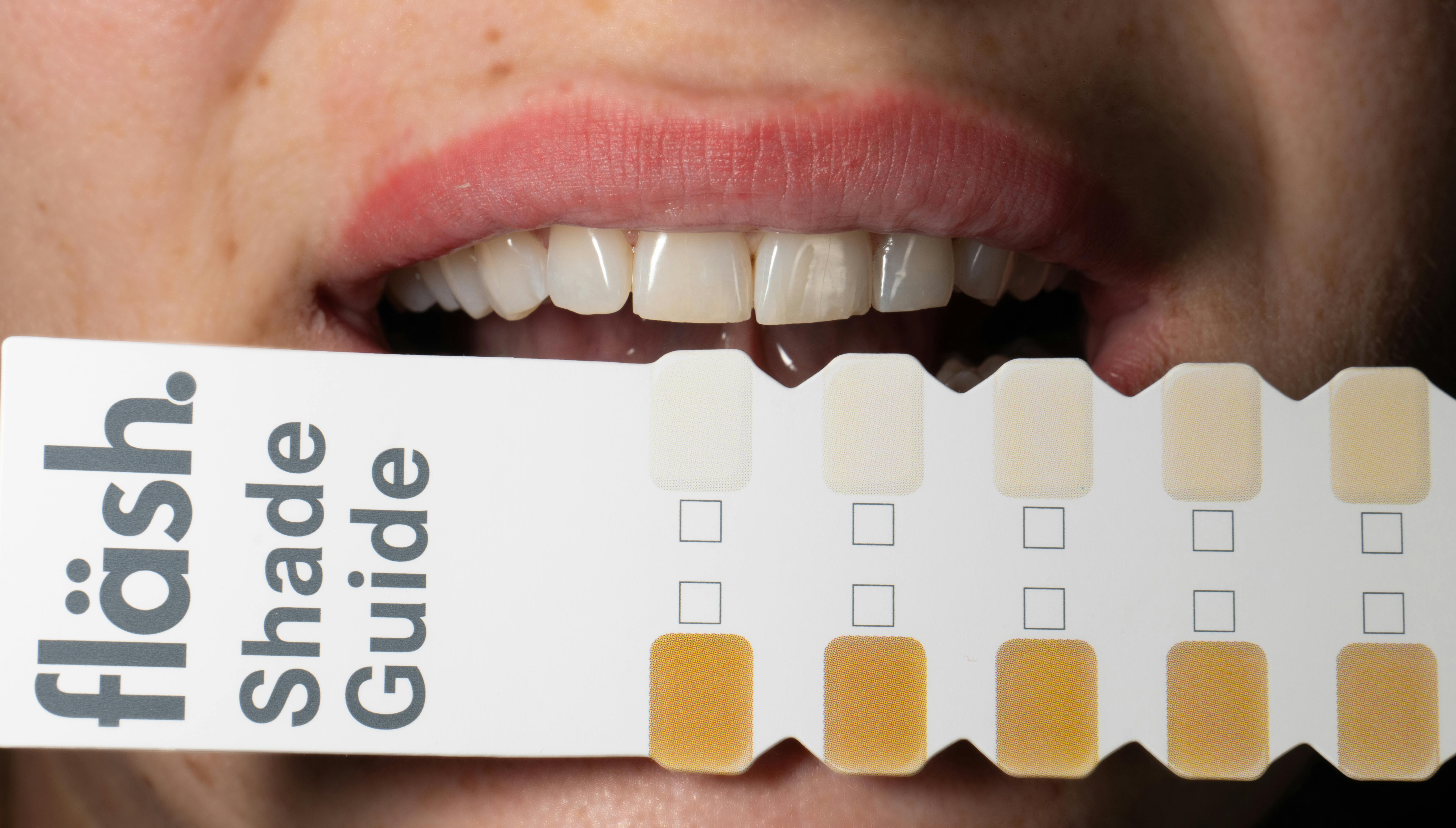
Whitening products do not scrub anything off the surface of a tooth. They pass through it, and the colour change happens within the tooth structure itself.
Enamel is permeable at a molecular scale
Enamel appears solid but is composed of mineral rods separated by microscopic spaces containing water and organic material.
Small molecules can diffuse through that network, and hydrogen peroxide is small enough to travel through enamel and into the dentine beneath.
This is the mechanism that separates whitening from polishing. A polishing paste removes surface film, while peroxide reaches pigment the paste can never touch, which is why the two procedures address different kinds of discolouration.
Colour comes from double bonds
Stain molecules absorb visible light because they contain chains of alternating double bonds, and the length of those chains determines the wavelength absorbed.
Peroxide breaks down into reactive oxygen species that attack precisely these bonds, splitting the long chains into shorter fragments.
Shorter fragments absorb light outside the visible range, so the molecule stops contributing colour even though it may still be present in the tooth.
Carbamide and hydrogen peroxide are related
Carbamide peroxide breaks down in the mouth into hydrogen peroxide and urea, so both product types deliver the same active agent.
The breakdown is gradual, which means carbamide formulations release peroxide more slowly and at a lower concentration over a longer period.
That difference explains why some systems are worn overnight while others act within a shorter supervised appointment. Concentration and contact time trade against each other.
Results plateau rather than continuing indefinitely
Once the accessible pigment molecules have been broken down, further application has progressively less to act on and the visible change slows.
Continuing past that point increases exposure of the tooth and soft tissues without producing a proportionate improvement in shade.
Teeth also darken again gradually as new pigment accumulates from diet and from continuing dentine changes. The effect is therefore described as maintainable rather than permanent.
Why supervision is part of the process
Peroxide affects soft tissue as well as tooth structure, and gel contacting gums or spilling from an ill-fitting tray causes irritation.
Existing decay, cracks, exposed root surfaces and leaking restorations all change how peroxide behaves and can turn a routine procedure into a painful one.
A dentist checks for those conditions before treatment begins, which is the substantive difference between supervised whitening and an unassessed product.