
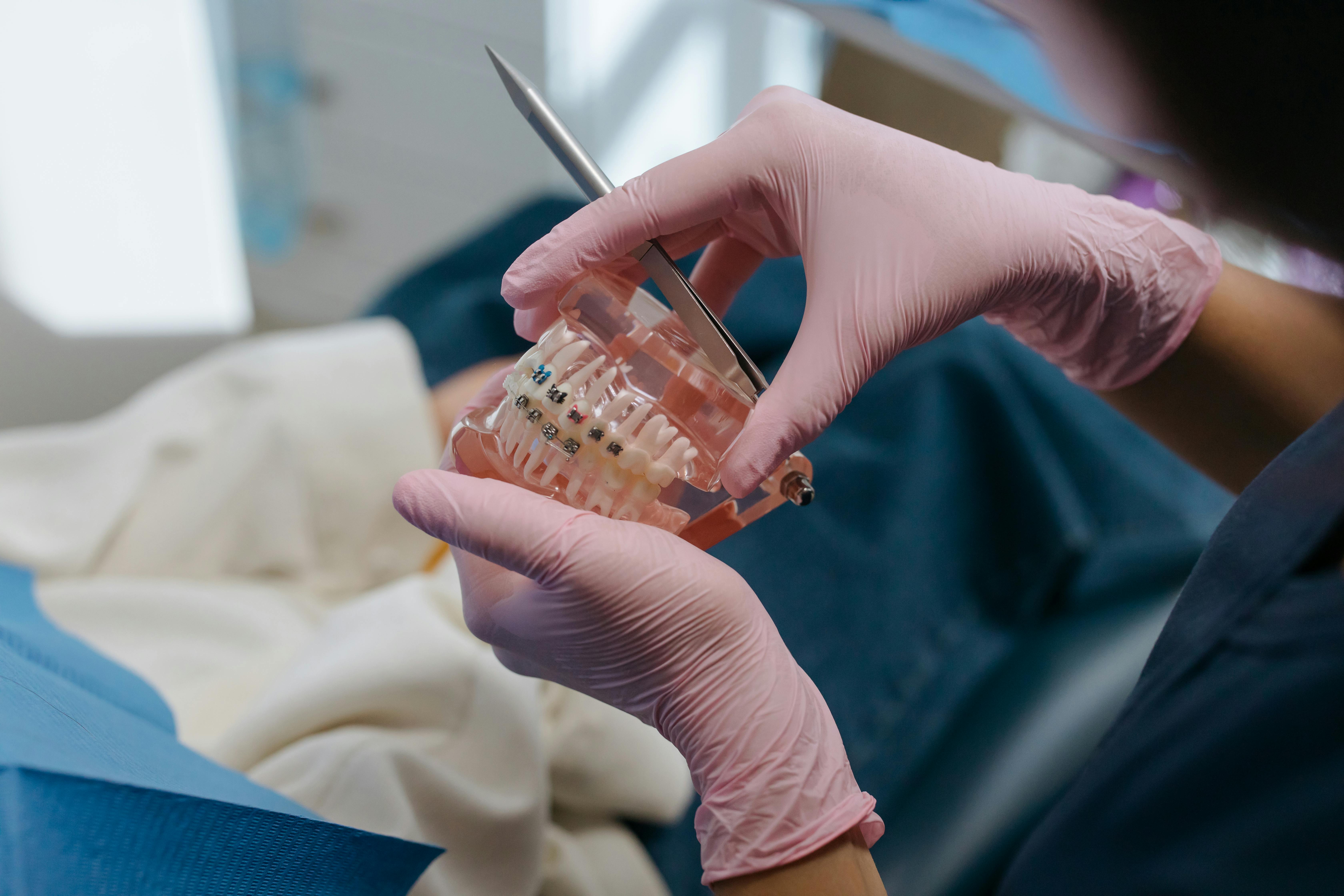
Teeth that have been straightened tend to move again once the appliance is removed. The tendency is normal biology rather than a sign that treatment failed.
Teeth are suspended, not cemented
A tooth root sits in a socket separated from bone by a narrow ligament made of collagen fibres. Those fibres hold the tooth and allow it slight movement under load.
Orthodontic force works by exploiting this arrangement. Sustained pressure prompts bone to resorb on one side of the socket and rebuild on the other, and the tooth migrates.
Because the tooth travels through remodelled bone rather than being locked into it, nothing about the new position is inherently fixed once the force stops.
The fibres take longer than the bone
Bone around a moved tooth reorganises over a matter of months. The gum fibres running above the bone, particularly those encircling the tooth, remodel far more slowly.
Until they do, those fibres remain stretched and store elastic tension that acts to rotate teeth back toward where they came from.
Rotations corrected during treatment are therefore the movements most likely to relapse, and they often begin to do so within the first months after removal.
Jaws keep changing after treatment ends
Facial growth continues into the late teens and the jaws keep altering slowly through adult life, generally in ways that increase crowding at the front of the lower arch.
This drift occurs in people who never wore braces at all, which is the clearest evidence that it is not caused by orthodontic treatment.
Retention is therefore holding a position against an ongoing process rather than waiting for a healing period to finish.
What retainers do and do not do
A retainer holds teeth where they were left. It does not strengthen the attachment or accelerate the remodelling, and it exerts no meaningful corrective force of its own.
Fixed retainers are wires bonded behind the front teeth and work without being remembered. Removable ones depend entirely on being worn as instructed.
A retainer that has become tight has usually been left out long enough for movement to occur, and forcing it back in is not the answer. That is a reason to see the treating clinician.
Why the plan is usually indefinite
Because the underlying drift never stops, most orthodontists describe retention as continuing at a reduced frequency rather than ending at a fixed point.
Bonded wires can debond silently, and a broken retainer that goes unnoticed for months allows exactly the movement it was placed to prevent.
Periodic checks exist for that reason, and any change in fit or feel is worth reporting rather than watching.